


Today is Wednesday, October 28th. Halloween is three days away and we hope you have your costumes already. Preston and I went by a graveyard yesterday and you wouldn’t believe the line outside… people were dying to get in! The US midterms are also 6 days away. Our first story is about the US midterms and what certain results could mean for the industry while our second story is about a new report that calls for the Pentagon to stop buying KC-46 refueling craft in order to prepare for war with China.

Defense Hawks Face Reckoning as Midterms Threaten to Reshape Congress’s National Security Ranks
With a week to go before the Nov. 3 midterm elections, polls point to Democratic gains. Forecasters expect the party to win the House and potentially even flip the Senate. For the defense world, that could mean a sweeping change in who writes the Pentagon’s budget and oversees its programs. Several longtime defense leaders are retiring, and others face difficult races. Here are three major races we’re watching:
In Maine, Sen. Susan Collins, the Republican chair of the Senate Appropriations Committee, is defending her seat against Democrat Troy Jackson. Jackson replaced Marine veteran Graham Platner, who withdrew from the race over sexual misconduct allegations. Collins also faces fallout from a ProPublica report that the FBI had planned a pay-to-play probe tied to a defense contractor’s donations.
In Virginia, Rep. Rob Wittman, a Republican who leads a House Armed Services subcommittee, is in a competitive contest against prosecutor Shannon Taylor. If he wins and Democrats take the House, he is seen as the frontrunner to become the committee’s top Republican. Reps. Trent Kelly and Ronny Jackson have also expressed interest in the post.
In California, redistricting has pitted two Republicans against each other. Rep. Ken Calvert, who chairs the House Appropriations defense subcommittee, faces Rep. Young Kim in the 40th District. Defense firms and Palantir’s top executives have been prominent donors to groups backing him.
Elsewhere, Alaska Sen. Dan Sullivan, a Republican on the Armed Services Committee, faces Democrat Mary Peltola and an independent who shares his name. The Trump administration has sued to block certification if a Republican loses, citing voter confusion. In Michigan, former Rep. Mike Rogers is locked in one of the cycle’s tightest Senate races against Democrat Abdul El-Sayed. If Democrats win the House, Rep. Adam Smith is positioned to chair Armed Services.
Several defense heavyweights are also leaving at year’s end: Senate appropriators Mitch McConnell and Dick Durbin, Sens. Jeanne Shaheen, Gary Peters, and Reps. Don Bacon, Seth Moulton and Elise Stefanik.

Hudson Institute report warns current refueling fleet and forward bases are too vulnerable in a Pacific conflict
The U.S. Air Force’s aerial refueling fleet is a decisive advantage, but it could be neutralized in a war with China. That is the central finding of a new Hudson Institute report, which urges the service to field a new long-range tanker and harden its airfields.
The report, Resilient Reach: Redesigning Aerial Refueling for Contested Global Operations, was written for the Hudson’s Center for Defense Concepts and Technology. It warns that suppressing tanker operations “could collapse US air operations” and contribute heavily to a U.S. defeat in a war with China.
The authors say the Chinese military can deliver thousands of munitions a day near its coast and is extending its reach. By 2035, they write, it could potentially suppress large-scale, sustained tanker operations from forward airfields in the Western Pacific. Most refueling in recent conflicts, including Operation Epic Fury, has launched from uncontested airfields close to the action. A Pacific war could force tankers to operate from much more distant bases. Tankers are also vulnerable in the air. That could force them to stand so far off that receiver aircraft burn most of their fuel in transit and have little time on station.
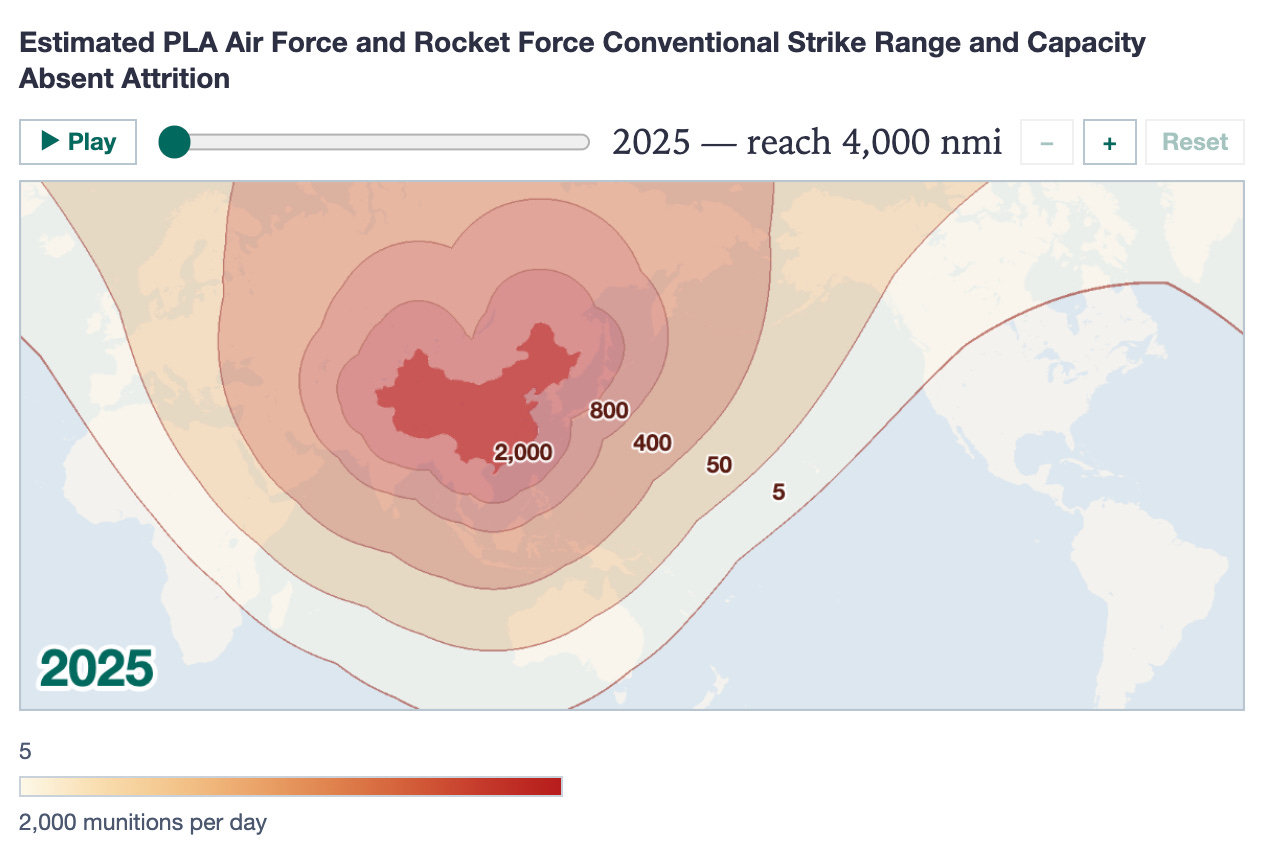
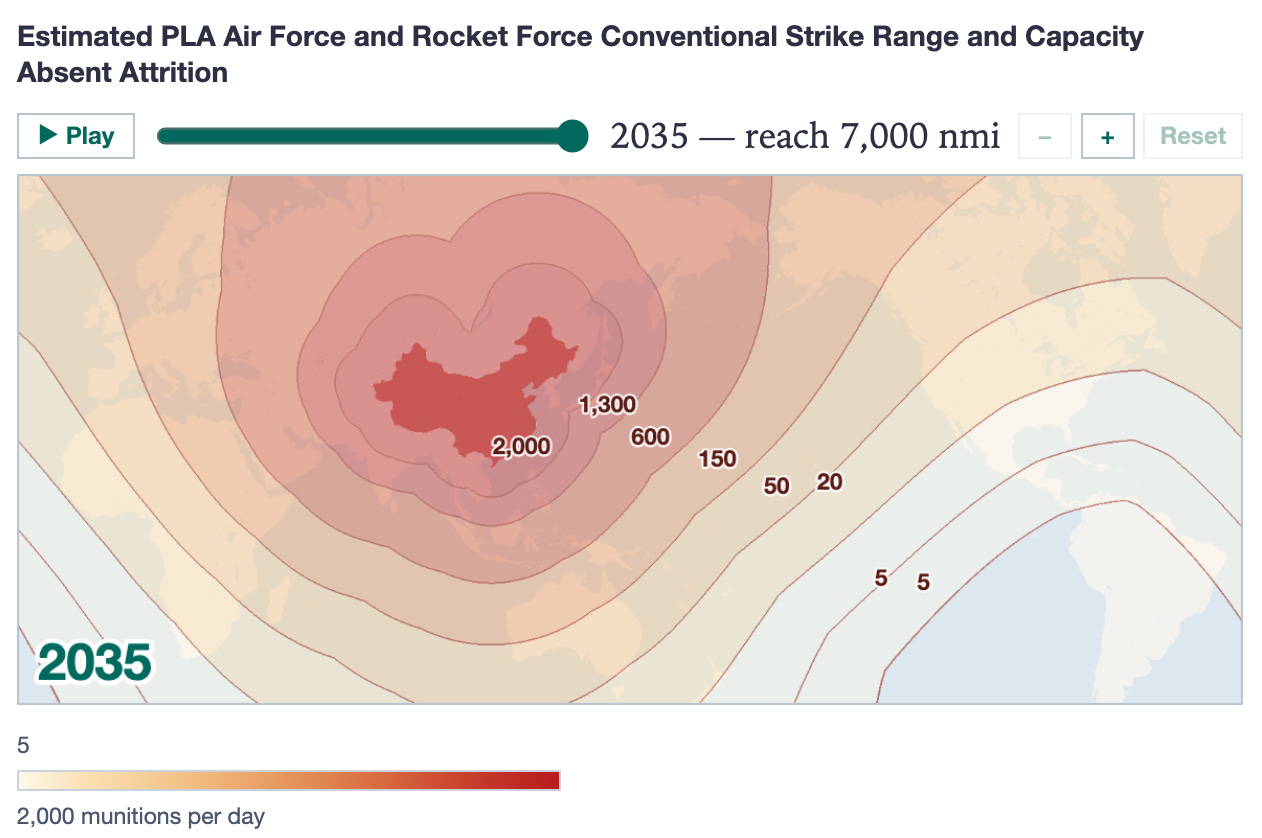
The report illustrates the problem with the fighter-escort math. Supporting a single continuous four-fighter air patrol takes as few as six F-35As airborne, but as many as 58 as the distance to the tanker grows. Tankers able to approach to 300 nautical miles of the patrol would need 14 fewer fighters aloft than those holding at 600 nautical miles.
The authors compared five representative tanker types: the Boeing KC-46A, the Airbus A330 MRTT+, a medium-sized blended-wing body (BWB), a medium-sized reduced-signature design, and a Collaborative Tanker Aircraft. They tested them across 32 scenarios in the Pacific, North America, Europe and the Middle East.
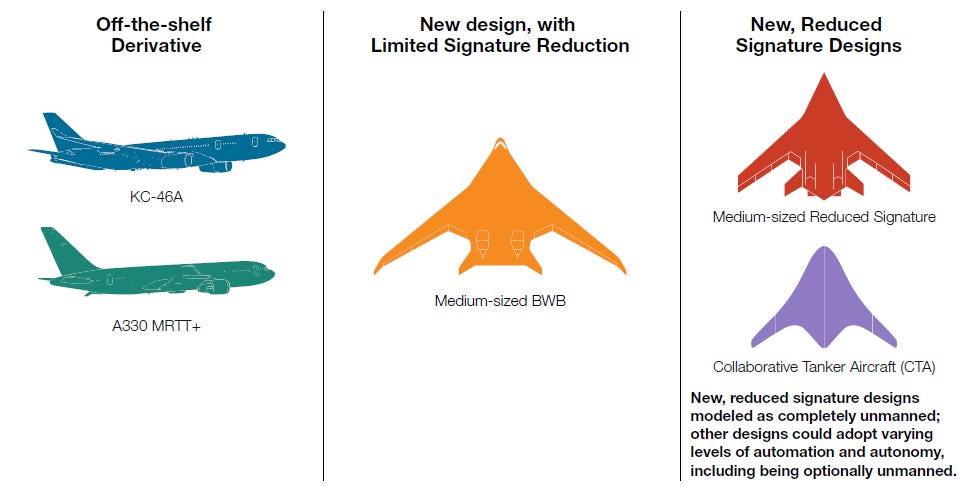
They found the KC-46A, while effective in recent operations, lacks the range, offload and survivability for large-scale refueling across the Indo-Pacific, even with force-extending measures. The slightly longer-range A330 MRTT+ faces similar limits.
Smaller reduced-signature “shuttle” tankers, which would work with parent tankers like the KC-46A to refuel inside contested airspace, could help a small number of force packages. But they would struggle at scale, and their operations would depend on vulnerable parent aircraft.
The blended-wing design performed best. Compared with 250 KC-46As, the report says 250 medium BWB tankers could:
refuel more than twice as many force packages, or the same packages more than twice as far;
deploy forces across the Pacific more than twice as fast;
sustain protracted operations under attack;
cost $15.5 billion less over 30 years.
At longer ranges and higher offloads, the BWB could deliver up to five times as many operationally relevant increments of fuel as the KC-46A. It could also sustain orbits from more than twice as many airfields, including safer ones in the continental United States. The authors attribute the lower cost to its medium size, lighter weight and refueling-only design, compared with multi-role tankers.
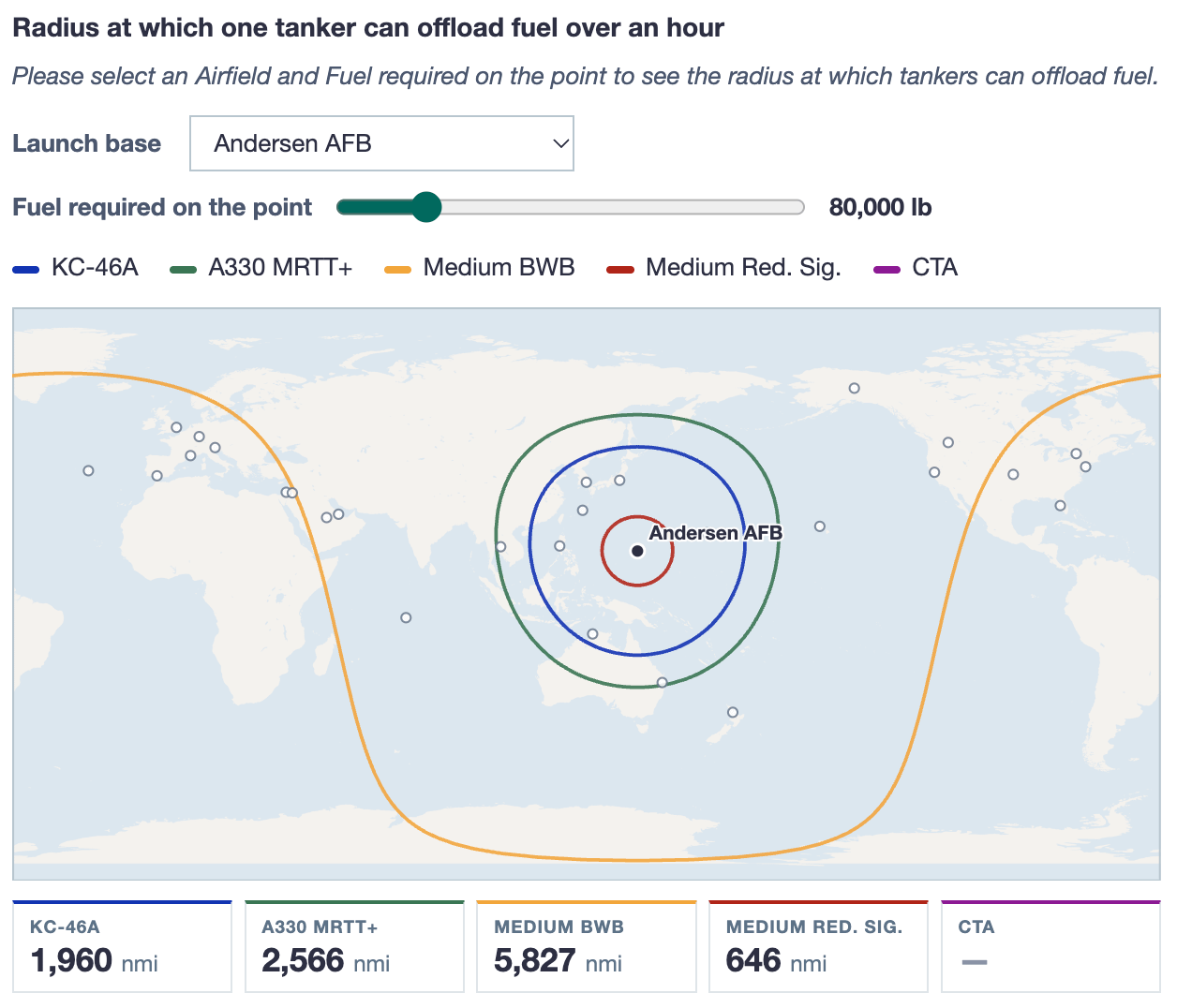
In one scenario, $8 billion spent on tankers flying from Andersen Air Force Base in Guam buys roughly twice as many F-35As on station over Taipei with the BWB as with KC-46As or A330 MRTT+s. The shuttle designs could support more fighters but at much higher cost: an extra $4 billion buys five more F-35As with the collaborative design, and an extra $12 billion buys 11 more with the reduced-signature design.
Maintaining five F-35A patrols along the First Island Chain would cost about $21 billion with BWB tankers if they refuel from forward airfields. That rises to $34 billion if only distant airfields are available. The lowest-cost shuttle option climbs from about $24 billion to about $80 billion in the same shift. The cost totals include both tankers and fighters.
Recommendations
The authors say the Air Force and the Department of War can transform the tanker architecture within planned budget levels by:
Boosting the resilience of its most important tanker airfields.
Adding adaptive mission systems to current tankers to improve effectiveness and survivability.
Fielding a medium-sized, long-range, high-offload tanker, such as a medium BWB, capable of flying a modest distance into contested airspace.
Of five year-by-year fleet plans modeled, the report says one that introduces the BWB would cost $15.5 billion less over 30 years than buying only KC-46As, while delivering 58 percent more offload capacity. The authors note the approach could be funded with additional money or in a budget-neutral way by reducing KC-46A production-extension purchases to pay for BWB development.
The authors acknowledge limits to their findings. In some short-range, small-scale cases, shuttle tanking would be cheaper than the BWB, and reduced-signature designs would be more survivable than conventional tankers.

That’s all from us today! Preston will be back tomorrow with a new video! Have a great rest of your week.